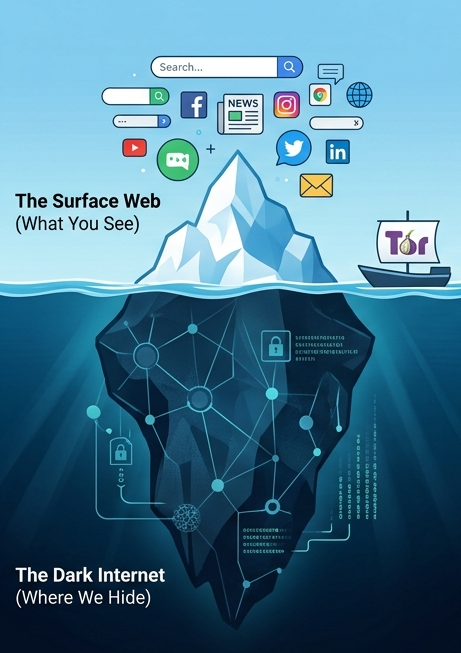
Imagine the internet as a massive ocean. The websites you visit every day—Google, YouTube, news outlets, and online stores—make up just the very surface of that water. This is known as the Surface Web, and it accounts for only about 4% to 10% of the entire internet.
But if you dive deep beneath the waves, past the reach of search engines, you enter a massive, hidden realm. Deep down in the trenches lies the most misunderstood corner of the digital world: The Dark Internet (more commonly known as the Dark Web).
It is a place shrouded in mystery, urban legends, and cinematic hacker myths. But what actually happens down there? Let’s turn on the lights and explore.
Why is it Called the “Dark” Internet?
It’s not called “dark” because it’s inherently evil, or because it runs on a different type of electricity. It is called the Dark Internet simply because it is hidden from view.
Standard search engines like Google use automated bots to “crawl” the web, indexing pages so you can search for them. The Dark Internet is built on networks that explicitly block these bots. It exists in the shadows because it cannot be mapped by traditional means, requiring specialized software to access. It is “dark” because, to the rest of the world, its users and servers are completely invisible.
The Surprising Origin: Born from the Military
If you think the Dark Web was invented by a mastermind cyber-criminal in a hoodie, you’re in for a surprise. It was actually created by the United States government.
In the mid-1990s, scientists at the U.S. Naval Research Laboratory realized that the open internet wasn’t safe for sending highly sensitive intelligence communications. If anyone could track where a message was coming from, secret agents and military operatives would be exposed.
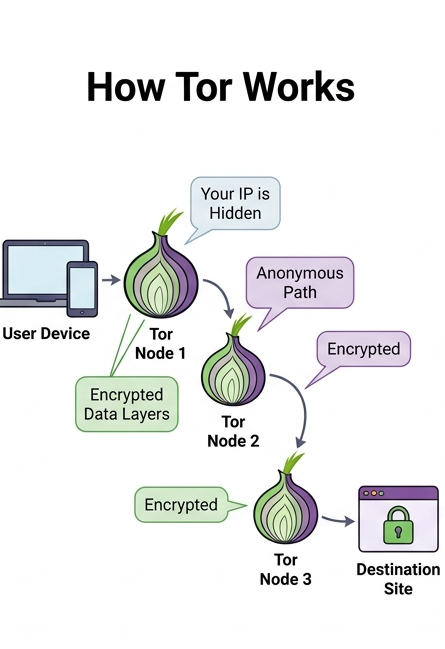
To solve this, they developed a technology called Onion Routing. The idea was to wrap data in multiple layers of encryption (like the layers of an onion) and bounce it through a global network of random computers. By the time the data reached its destination, the original sender’s identity and location were completely erased. In the early 2000s, this project was released to the public as an open-source project, which we now know as Tor.
What is a Tor Browser?
You can’t access the Dark Internet using Google Chrome, Safari, or Microsoft Edge. If you type a Dark Web address into Chrome, you will just get an error screen. To step into this hidden world, you need a key, and that key is the Tor Browser.
“Tor” stands for The Onion Router.
The Tor Browser looks and feels just like a regular web browser, but it works completely differently behind the scenes. Instead of connecting your computer directly to a website, Tor routes your traffic through at least three different encrypted computers (called nodes or relays) around the world.
- The first computer knows who you are, but not where you are going.
- The second computer just passes the data along.
- The third computer knows where you are going, but not who you are.
Because of this, websites cannot see your real IP address, and your internet service provider cannot see what websites you are visiting.
Where Can It Be Downloaded From?
The Tor Browser is completely free and legal to download in most countries. To stay safe and avoid malware, it should only be downloaded from its official source:
- The Official Website: torproject.org
The Two Sides of the Coin: How the Dark Internet is Used
The Dark Internet is like a hammer: it’s a tool. You can use a hammer to build a house, or you can use it to break a window. Because it offers absolute privacy, it attracts a diverse crowd.
1. The Good (and Necessary) Uses
- Privacy and Free Speech: For journalists, whistleblowers, and political activists living under oppressive regimes, the Dark Web is a literal lifesaver. It allows them to communicate, report news, and expose corruption without fear of government tracking or arrest.
- Bypassing Censorship: In countries where major news sites, social media, or search engines are blocked, citizens use Tor to access the open, global flow of information. Even mainstream giants like the BBC, the New York Times, and Facebook maintain official versions of their sites on the Dark Web for this reason.
- Secure Corporate Communications: Businesses use dark networks to protect trade secrets, move highly sensitive data, and secure internal communication lines from corporate espionage.
2. The Bad (The Shadow Marketplace)
Because identities are hidden, criminals naturally flocked to the Dark Web. It hosts underground marketplaces where users can buy and sell illegal goods, ranging from hacked data and stolen credit cards to illicit substances and malware. While this makes up the majority of the Dark Web’s reputation in pop culture, it is only one piece of the puzzle.
Want to Build on the Dark Web? We Can Help!
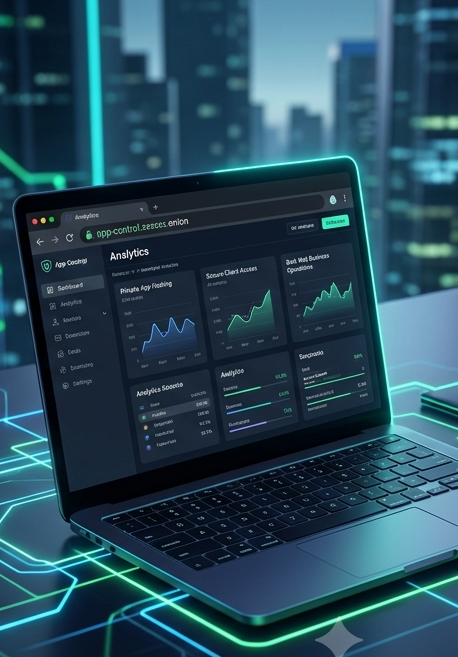
The websites on the Dark Internet don’t end in .com, .org, or .net. Instead, they end in .onion—a special top-level domain suffix that can only be resolved by the Tor network.
Running a web application or platform on a .onion domain provides unparalleled security, censorship resistance, and privacy for your business, data storage, or application.
Setting up, configuring, and deploying a secure app on the dark internet can be technically complex and risky if done wrong. That is where we come in. Whether you need a highly secure, private platform for internal corporate operations, an un-censorable application, or you simply want to establish a secure .onion presence for your existing platform, we can handle the heavy lifting. We specialize in building, containerizing, and securely launching web applications onto the Tor network.
Contact us today via website or WhatsApp Chat to talk about launching your secure .onion application!